











The design of the new Marconi–Lévinas school complex in Merano in northern Italy was conceived during a two-stage architectural competition launched by the Autonomous Province of Bolzano in 2013. The brief was to create new homes for two institutes: the Guglielmo Marconi Provincial Professional School for Craftsmanship, Industry, and Business, and the Emmanuel Lévinas School for Social Professions.
The area for the project is located in Maia Bassa, a district nestled between the Adige and Passirio rivers; its name is probably derived from the ancient Roman customs station, Castrum Maiense. Although now fully incorporated into Merano, the Maia Bassa area still retains its original structure, influenced by the imposing geometry of the barracks and by the racecourse that intersects them.
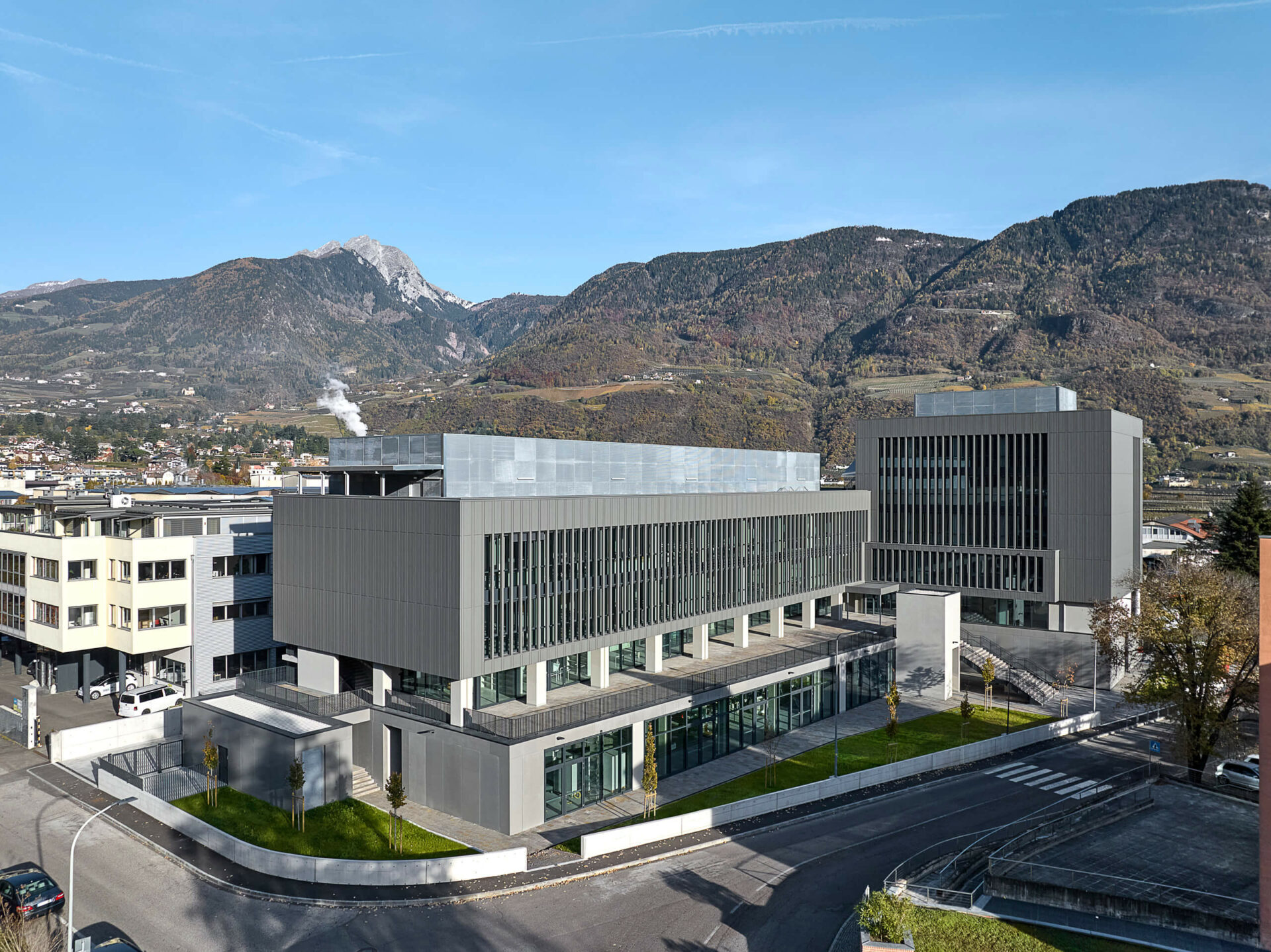
The plot housing the new schools is at the southern edge of the district, along via Scuderie. Here, homes, manufacturing businesses, and major infrastructure coexist in an architectural melting pot that juxtaposes multiple styles. The project sought to increase the legibility of this poorly defined area through a simple yet effective creation: a linear building, in dialogue with a tower that faces onto the street, mediating the relationship with the public space, and a raised square/parterre that brings the two together.
Organizational principles and compositional themes
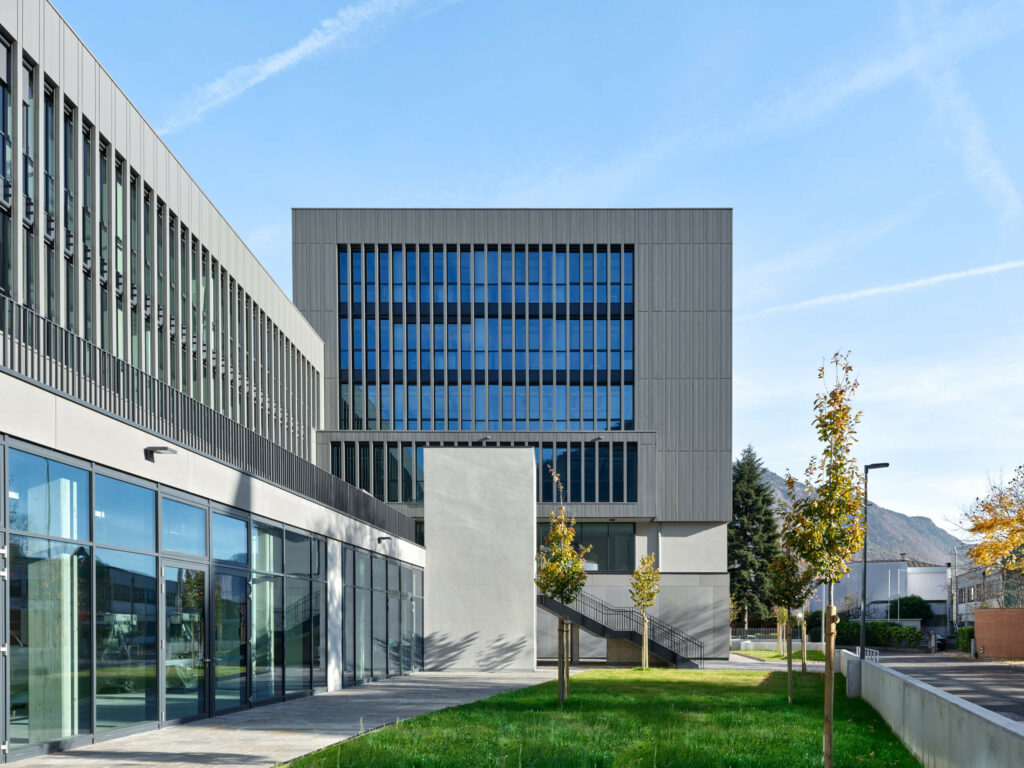
The combination of the linear structure and the tower highlights the school’s architectural independence from its surroundings, and ignores traditional forms. The specialist teaching environments are distributed across the two buildings, connected by a shared atrium — directly accessible from the raised square — which contains the main facilities used by both institutes. The tower is home to the Lévinas School, while the linear building houses the Marconi School. Each of the latter’s storeys has a different theme: the laboratories and mechanical workshops are on the podium, while the electronics workshops, classrooms, and business department are on the levels above. The basement contains a car park and two gyms.
This organizational and compositional system provides a clear layout for the communal spaces — the multifunctional room, library and gyms — which can also be accessed outside normal teaching hours. Externally, the existing vegetation was fully preserved, and small flowerbeds and rows of tall trees were added.
Architecture
The new school complex takes the form of a single construction divided into three parts.
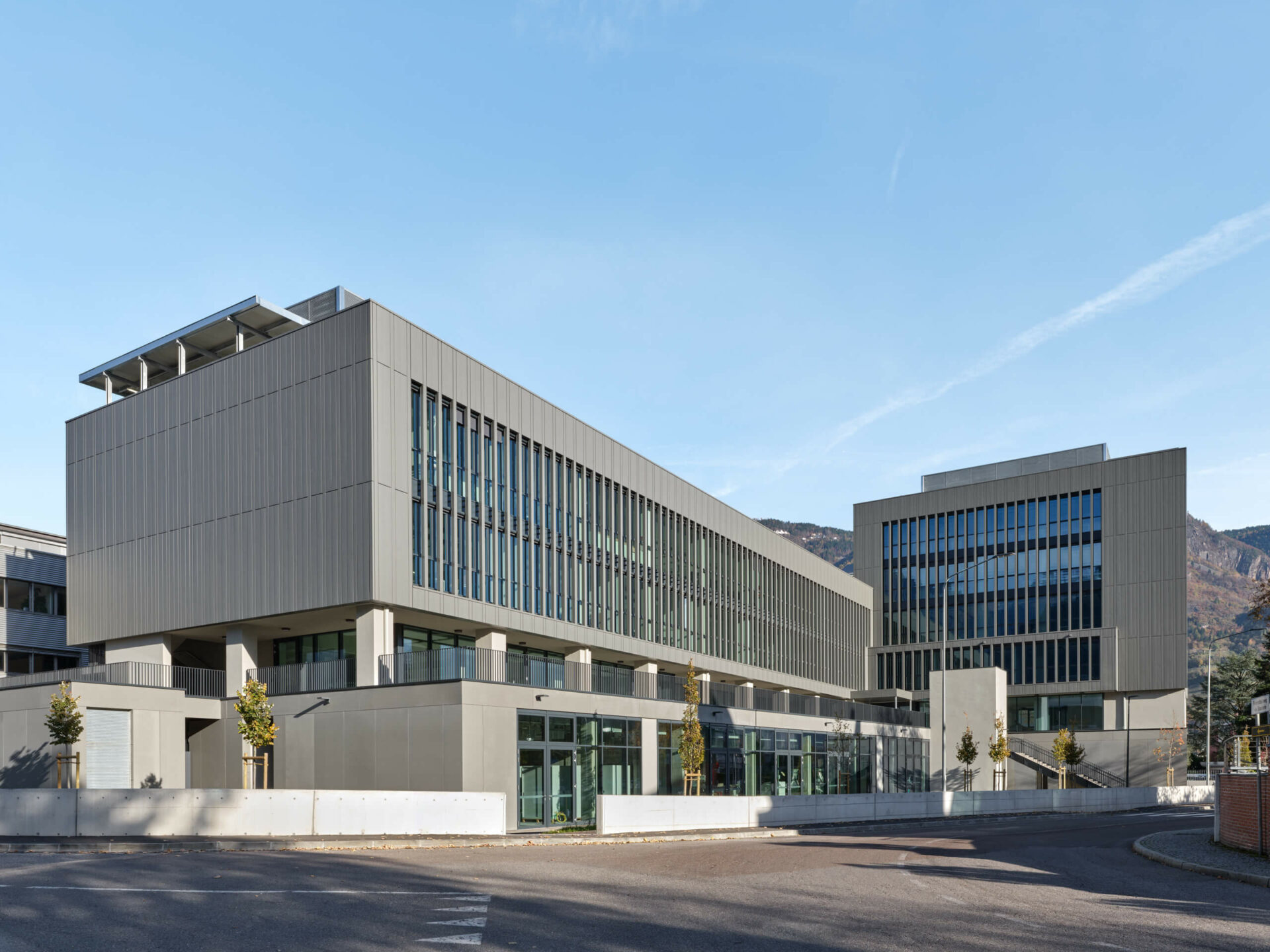
There is a podium with artificial terrain that remodels the location’s profile, reflecting the Alpine ridge as its backdrop. There are also two supporting units, one that extends lengthways and one vertically, seemingly suspended in mid-air.
These juxtaposed volumes produce a simple and austere design devoid of superfluous elements; a composition of pure forms that seeks to provide a succinct yet recognizable image of “school” as an environment dedicated to education.
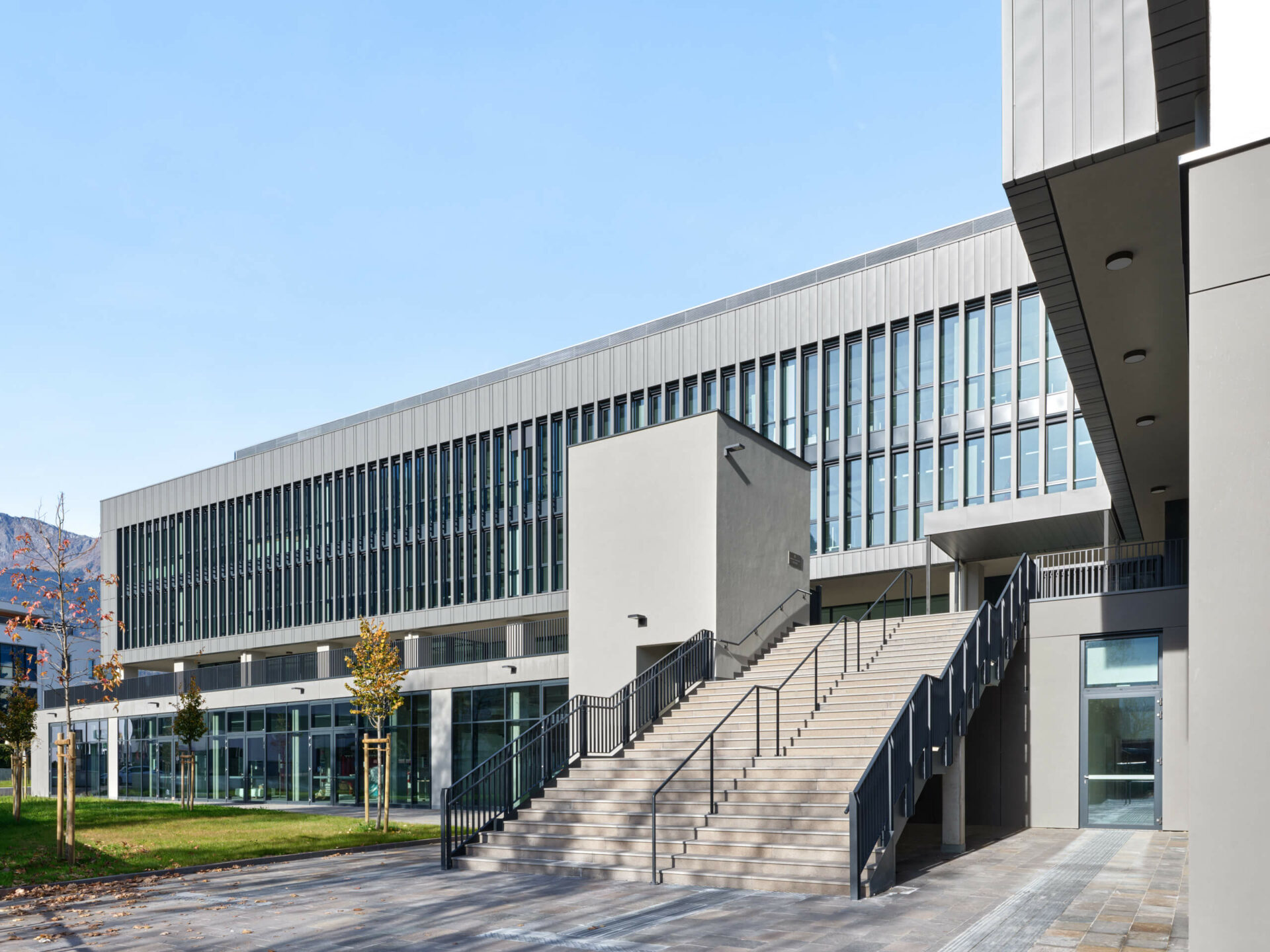
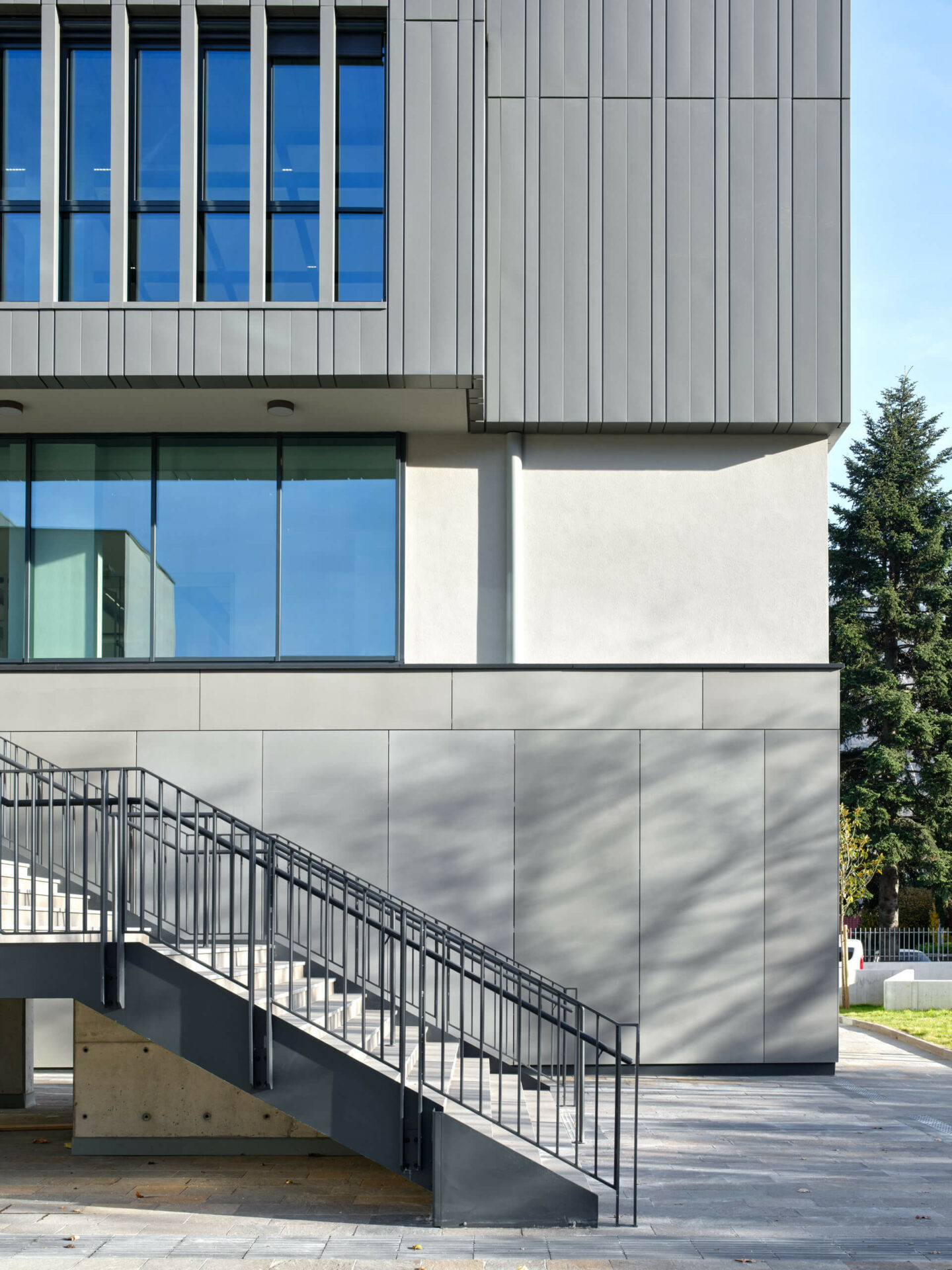
While aiming for expressive consistency, the volumes nevertheless retain their own figurative and technical autonomy. The linear building extends lengthways, organized around a central corridor and split into three above-ground floors plus a basement. On the first level, contact with the podium is mediated by a long, full-height ribbon window that defines the building’s street presence, while the upper floors jut out, creating a sort of porch opening onto the parterre, reached via a grand staircase or a lift.
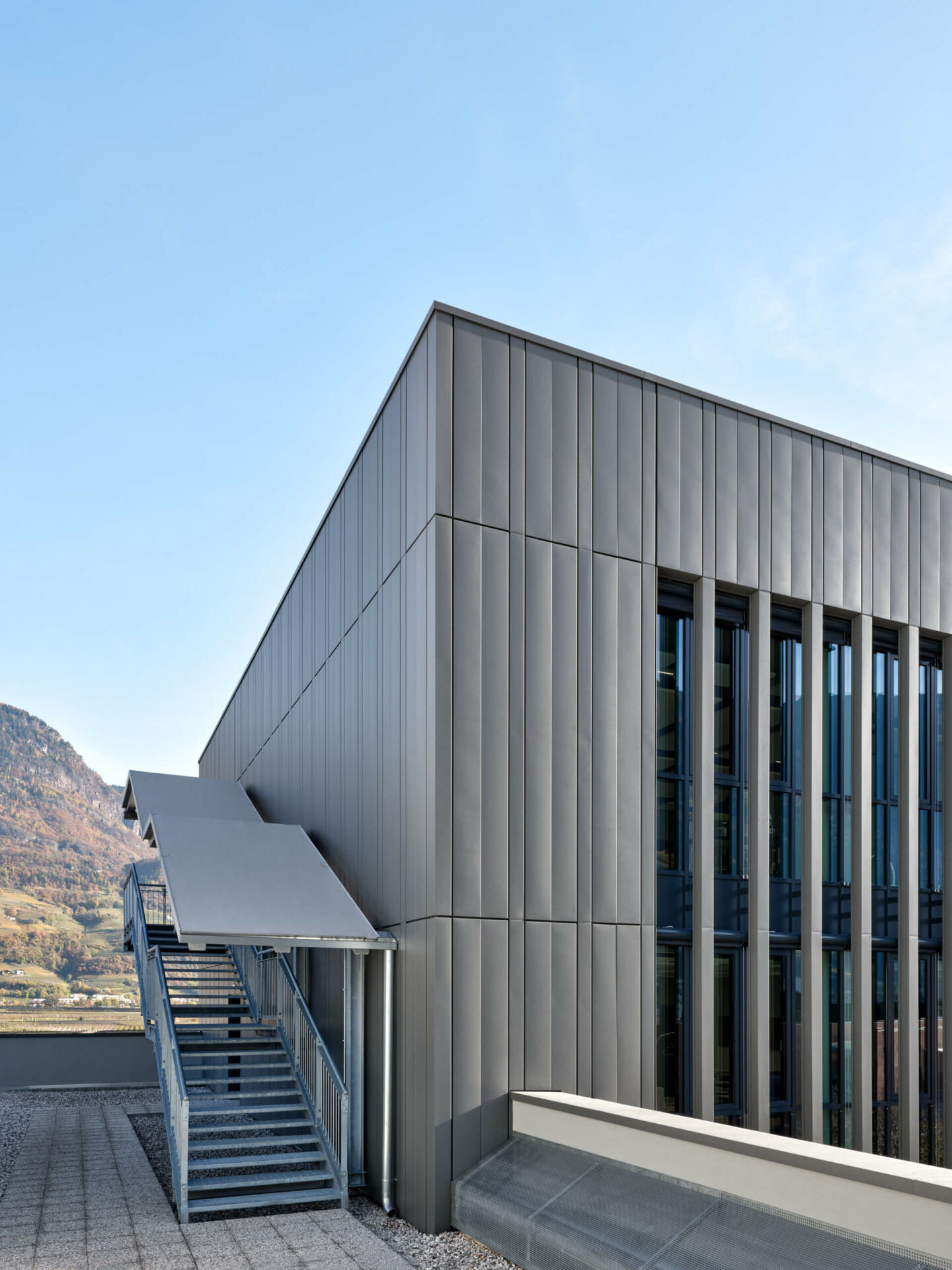
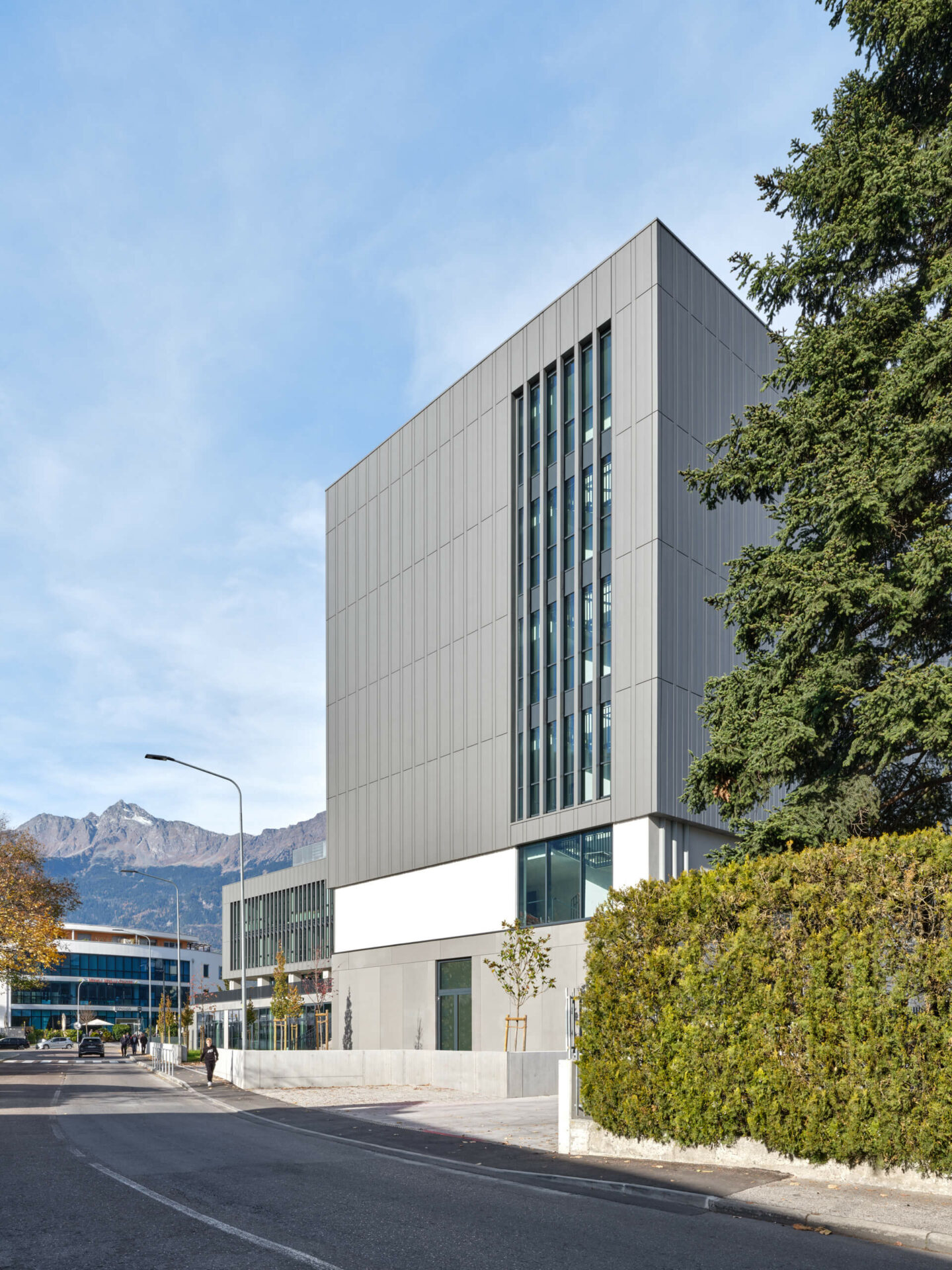
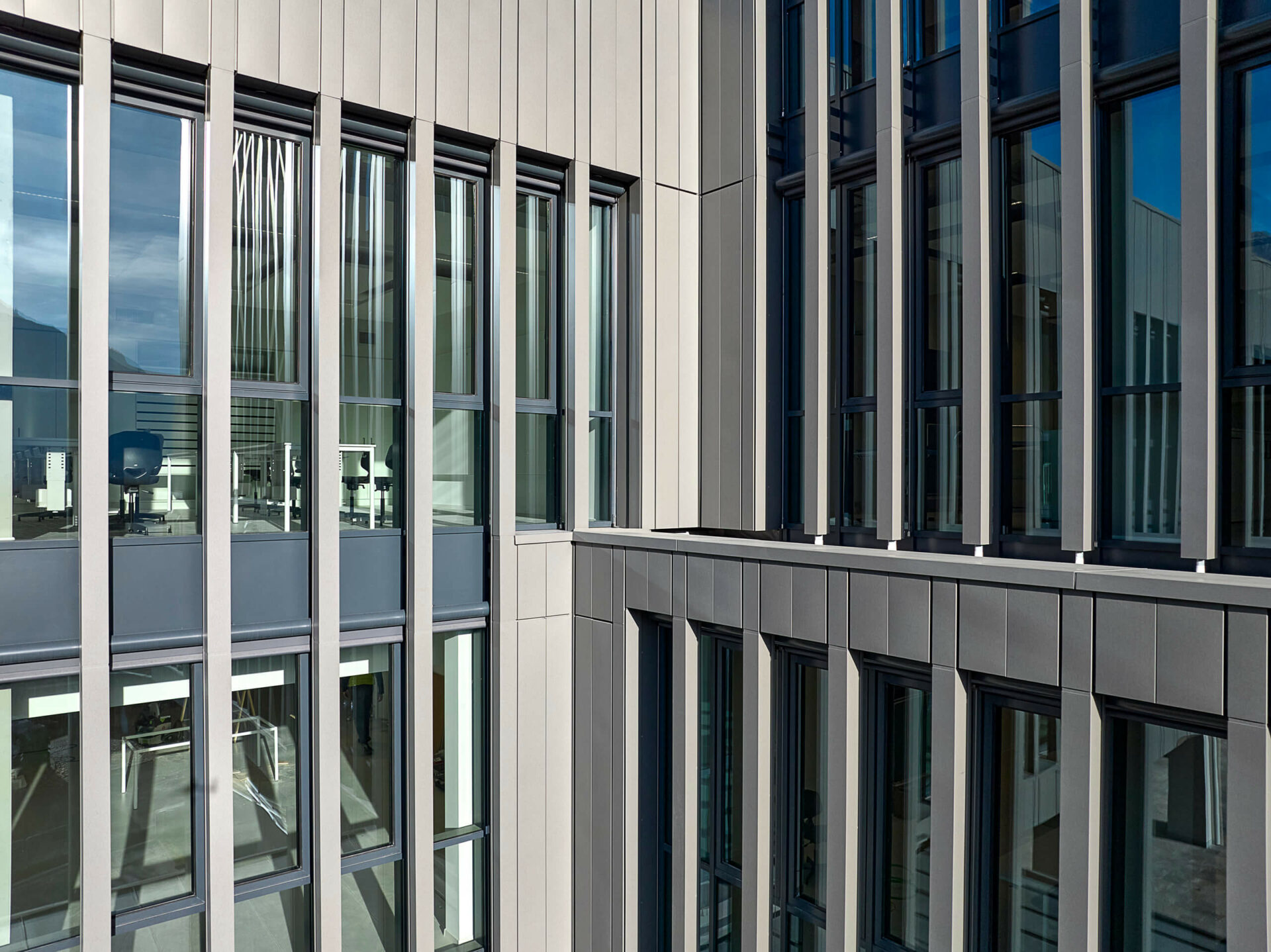
The tower further simplifies the distribution of volumes; the façade’s surface and a slight overhang in the direction of the square define its character. The repeated, modular, vertical titanium-zinc zintek® strip cladding, sized to match the distances between the structural elements, conceals classrooms and labs accessed via a central corridor.
The two schools’ shared spaces and facilities are on the raised floor, which channels natural light and air directly into the labs, improving the quality of the work environments, and shaping the transition from the public space of the street to the more sheltered, glazed atrium.
Internal spaces
The organizational layout and distribution of spaces follows a regular grid structure, making efficient use of the internal rooms, adaptable to any changes in use.
The rows of desks in the linear building’s classrooms are oriented to take full advantage of natural light, and the furnishings and equipment (cupboards, slide-out whiteboards, screens, and projectors) can be set up in various configurations, to provide advanced teaching options. The labs are designed for practical activities, with clearly defined equipment areas and internal walkways, large enough for both students and materials to move around safely.
The Lévinas tower also has an access corridor running through it, but here, it is laid out asymmetrically to separate the row of classrooms from the utility rooms. The regular classrooms and IT labs have a similar setup to the Marconi building; the laboratories are designed for experimental activities, and combine technical equipment with spaces for desk-based teaching.
External spaces
The architects believe that quality design depends not only on architectural features but also on the building’s relationship with the surrounding environment. They therefore focused significant attention on the outside areas, despite the limited space available. They created two green parterres along via Scuderie and one on the intersection with via Kuperion, accompanied by rows of tall trees. The vegetation around the building provides passive control over the microclimate: it fosters evaporative cooling and air humidification, creates shade, and reduces the amount of solar radiation reflected towards the façades. As a result, the design produces an aesthetically pleasing landscape while also meeting environmental sustainability goals.
The other key element is the raised square/parterre, which brings the schools’ inside spaces outside, by providing access to the two structures, and offers students and staff a place to rest and meet during breaks.
Construction
All design choices — the raw materials, forms, orientation, and relationship between solids and voids — are consistent with the demands of sustainable architecture, seeking to optimize energy consumption, construction methods and maintenance costs.
Sustainability was achieved by combining active systems with careful use of resources: using traditional techniques and materials that suit the climate and context ensured durability, easy maintenance, and a low environmental impact over the course of the building’s life cycle.
The building envelope was also designed to minimize heat loss. The designers opted for a high-performance curtain wall that pairs titanium-zinc zintek® metal cladding with a layer of insulation on the masonry structure. This solution retains warmth in winter and prevents overheating in summer by integrating the external shading systems. The glazed surfaces are made with low-emissivity glass to limit heat loss in winter.
Radiant ceiling air-conditioning panels are used to manage the internal microclimate, fed by liquid from the district heating system with a low thermal gradient. A mechanical ventilation system with an enthalpy heat recovery unit and ducts in the corridors ensures ample air circulation. The air treatment units are located on the roof, to minimize the size of the indoor technical rooms. There are also solar thermal panels to supply hot water and heating, and a photovoltaic system that powers the heat pump and low-consumption internal lighting. A partitioned section of the roof that includes the various systems is accessible to Marconi School students for teaching purposes.
The inside finishes vary depending on how the spaces are used. The traditional classrooms have plastered walls and ceilings painted with washable paints; the Marconi School workshops, designed to house machinery, have exposed concrete block walls and unpanelled ceilings. The common and social spaces, like the large atrium on the first floor and the corridors, have plasterboard suspended ceilings.
Cladding
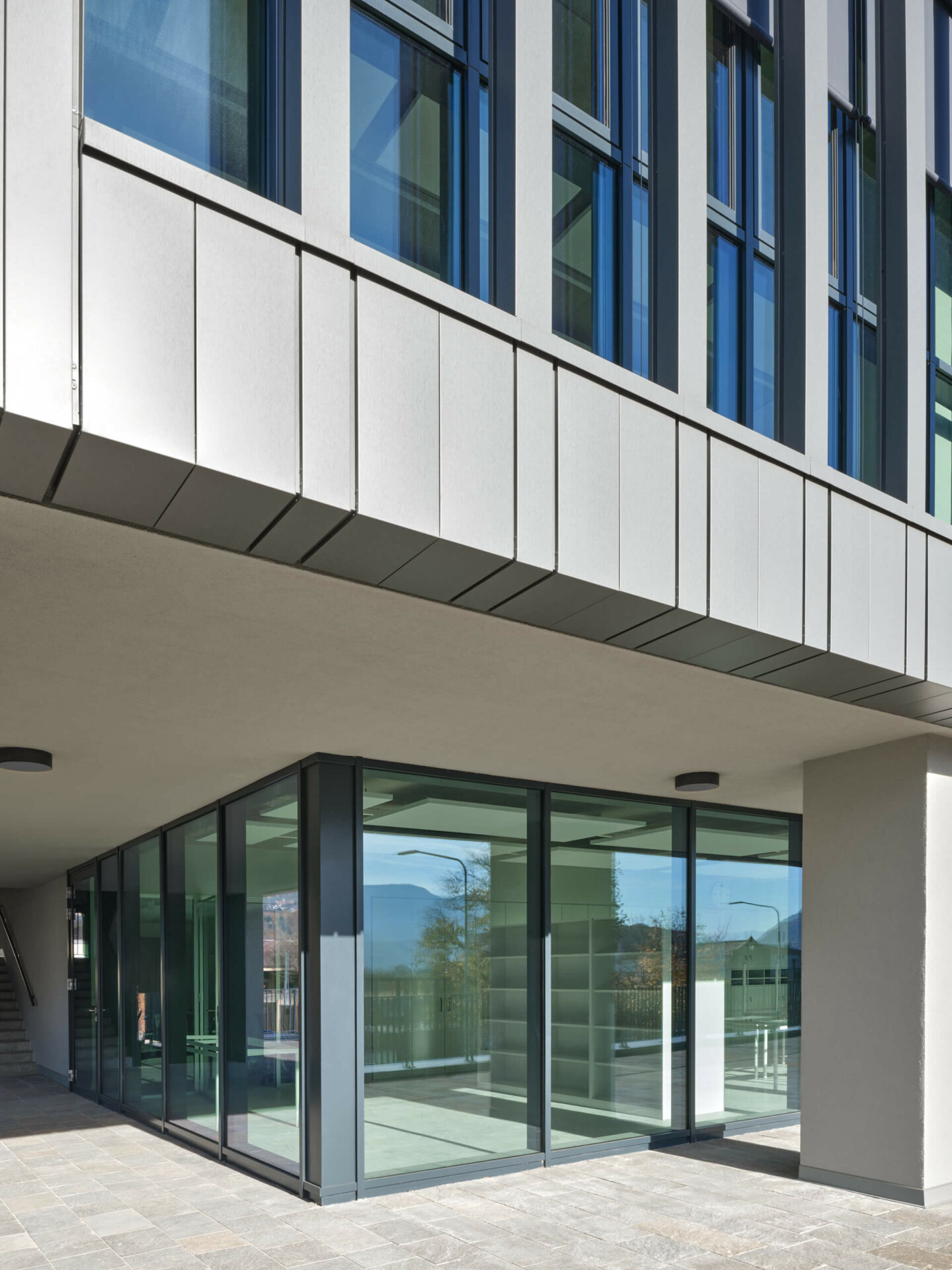
The structure of the base is clad in fabric-reinforced cementitious matrix composite panels, made with grey cement and silica aggregate, then strengthened with fibreglass, offering a good level of waterproofness and durability. The workshops on this level are visible from the street side through large windows, which were included for two reasons: to strengthen the link between inside and outside and give natural light to the more technical teaching spaces. This also provides a real-time view of activities within the school.
The glass “ribbon” on the first floor adds a lightness to the building, connecting the base with the linear building and tower above and projects the large atrium out towards the square/parterre.
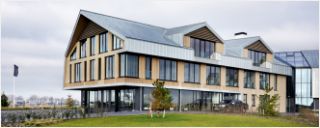
The upper volume has a single, unified façade design: the zintek® cladding defines the relationship between solids and voids and combines compositional value with technical performance. Fully opaque areas of cladding sit alongside sections that allow light to filter through — large windows shaded by vertical slats — depending on the specific exposure conditions and the needs of the inside spaces.
The choice of material and colour, with durability and performance also in mind, blends well with the surrounding manufacturing environment and represents the institute’s technical and professional vocation, helping to give it a clear and recognizable architectural identity.